March 11, 2026
BPC-157 vs TB-500: The Ultimate Peptide Therapy Guide
Struggling to heal an injury? Discover the exact differences between BPC-157 and TB-500 peptides, what they cost, and which protocol is right for you.
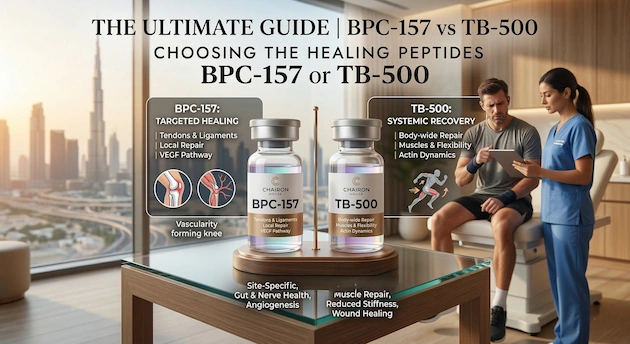
Stop guessing which peptide your body needs.
Imagine the following: you had a tendon injury a few months back. You took the proper treatment, and it should have healed after six weeks. But you still wake up with the morning stiffness. The inflammation is ruining your daily life.
The physiotherapy sections were perfect, and your bloodwork is clean.
What might have gone wrong? Traditional medicine can help diagnose the issue. How well does it boost the healing process? It’s questionable.
Practitioners basically suggest proper rest, standard physiotherapy sessions, and NSAIDs in treating musculoskeletal injuries. It works for some. In other people, in particular, those competitive sportspeople, in physically demanding jobs, and in general, adults over 40, whose tissue repair is slower healing, isn’t working out.
A Real Life Scenario
Meet James, an athlete who is in his thirties. He visited our clinic in Dubai for consulting for an Achilles tendon injury. It's months passed since the injury, and he has not been practising for months. He came to us after unsuccessful physiotherapy sessions. He was frustrated, saying that he was not recovering even after trying every possible way.
After a complete evaluation, we decided to start the combination of two healing peptides: BPC-157 and TB-500 in the treatment programme. The results? Within a few weeks, he resumed his athletic practice.
See, this is not the same for every case. However, the moral of the story is that targeted peptide therapy can be effective when there is no hope left with conventional recovery.
What Are BPC-157 and TB-500?
BPC-157
BPC-157 is a synthetic peptide consisting of 15 amino acids called Body Protection Compound-157 or abbreviated as BPC-157. It is the derivative of a protein in human stomach fluid.
The figure 157 is its sequence. It was first discovered by scientists who were researching how to treat stomach ulcers and has since been researched as far as its effects on tendons. For a dedicated deep-dive into how BPC-157 works and what to expect from a supervised protocol, read our full BPC-157 peptide therapy guide.
BPC-157
- Treatment Duration: 4–12 weeks
- Cost Range (AED): AED 800–2,500 per session/cycle
- Administration: Oral medicine or subcutaneous injection
- Treatment Outcome: 2-4 weeks
- Primary Use Case: The nerves, ligaments, and tendons are treated.
TB-500
TB-500 TB-500 is an artificial homolog of Thymosin Beta 4 (Tb4), a naturally occurring homologous peptide that can be identified in every human cell. It controls actin, which is a protein in the cell structure. TB 500 affects cell motility, wound healing, and the regulation of inflammation. For a comprehensive breakdown of how TB-500 works and the full protocol structure, see our TB-500 peptide therapy guide.
The two peptides are still investigational in most countries; they are administered only under medical supervision in clinical settings and are not licensed as pharmaceuticals.
Peptide treatments are permitted legally in the UAE, and the administration of these treatments is required to be done in a DHA-permitted clinic- a regulatory difference which is important to your safety (discussed in regulatory section below).
TB-500
- Treatment Duration: 4–8 weeks
- Cost Range (AED): AED 900–2,800 per session/cycle
- Administration: Intramuscular injection or subcutaneous injection
- Treatment Outcome: 3-6 weeks
- Primary Use Case: Alleviating the flexibility, muscle recovery, and orderly synthesis of tissues.
Why are UAE residents starting to ask more questions about these peptides?
The answer: The demography of the city of Dubai is unique:
- High population density of professional athletes
- Expatriate executives experiencing high physical and occupational loads
- An ageing but active population interested in preserving performance.
- Extreme heat (six months per year)
These characteristics also lead to distinctive physiological requirements of connective tissue and rest.
The Mechanism of Action of BPC-157 and TB-500.
How BPC-157 Works
BPC-157 acts in several overlapping pathways. The best studied one is the increase of the VEGF pathway (Vascular Endothelial Growth Factor), indicating the production of new blood vessels (angiogenesis). Damaged tendons and ligaments have a low level of vascularity, i.e., they get minimal blood supply and take a long time to heal. BPC-157 increases the speed at which new blood vessels grow into these tissues, and this increases nutrient and oxygen supply.
Another effect of BPC-157 is as follows:
- Regulation of the nitric oxide (NO) system
- Regulates inflammatory processes and vascular tone in the tissues.
- Modulates growth hormone receptor on tendon fibroblasts
Tendon fibroblasts are the cells that make collagen and repair connective tissue.
Within the gut, BPC-157 facilitates repair of the mucosal lining, and therefore is one of the few peptides that has strong pre-clinical evidence in the repair of the musculoskeletal and gastrointestinal mucosa. This gut-healing mechanism is also worth understanding in the broader context of how gut health drives systemic inflammation and recovery.
How TB-500 Works
TB-500 functions through the control of actin. It attaches to G -actin (the globular form of actin) and neutralises it, which regulates when and where structural proteins and motions of cells occur. Due to this, TB -500 is particularly practical in the initial parts of wound healing, whereby cells must travel into the damaged tissue to start repairing it.
TB-500 raises the amount of cell-surface receptors that facilitate migration. It suppresses inflammation through the regulation of the NF-kB pathway.
The NF-kB pathway is a significant inflammatory signalling pathway (Goldstein and Hannappel, 2007).
TB-500 spreads across the body. Its notorious size and high bioactivity allow TB-500 to spread throughout the body, unlike BPC-157, whose effect is primarily local to the injection site and thus may heal multiple tissues simultaneously. This systemic anti-inflammatory action is closely related to what we see when monitoring CRP and other inflammatory markers in patients undergoing recovery protocols.
BPC-157: Targeted Repair at the Tissue Level
BPC-157 works for injuries. This precise and localised peptide is effective in cases where there is no progress from the traditional treatments.
Tendon & Ligament Healing
Chronic tendinopathies like the rotator cuff, patellar, and Achilles respond to BPC-157. Patients who see no progress even after physiotherapy see a positive result within 4 to 8 weeks.
- Progress after a long plateau
- Reduced tenderness and pain
- Better load tolerance during the treatment
Gut & Digestive Health
BPC-157 is originally derived from a protein found in the gastric juice. Studies have shown that the peptide helps in GI repair.
Particularly for:
- IBD-spectrum conditions
- intestinal permeability conditions and leaky gut
- Gastric damage caused from NSAID’s long-term use
(Source: Sikiric et al., World Journal of Gastroenterology, 2016)
Nerve Repair
Studies done on animals report increased peripheral nerve regeneration. It’s a positive hope for patients recovering from post-surgical nerve damage and disc compression. It’s not only about the animals, but human evidence also states the same.
Inflammation Without the Trade-Off
BPC-157 lowers inflammation without down-regulating the immune system to allow patients to remain active and energetic.
TB-500: Systemic Recovery and Flexibility
TB-500 is effective for the whole body. Choose TB-500 if multiple areas of a human’s body need support, or when you look for speedy recovery.
Systemic Tissue Repair
Useful when there are recurring injuries like inflammation in the shoulder or a hamstring strain. Also effective in post-competition recovery and in treating overtraining syndrome. Results are normally seen within 3 to 6 weeks. For athletes specifically, this systemic recovery support fits naturally into a broader peptides for athletes programme.
Flexibility & Stiffness
The majority of patients report an improvement in joint mobility. Particularly those who spend hours in air-conditioned settings, whose muscular rigidity is weakened.
Cardiovascular Support
According to Philp et al., Annals of the New York Academy of Sciences, 2004, TB-500 has been tested in cardiac repair models, and the results?
A positive heart tissue recovery.
Wound Healing
Some ophthalmological reports show TB-500 peptide is capable of healing wounds. As per these reports, it is evident that TB-500 can be effectively used as a post-surgical recovery measure.
BPC-157 vs TB-500: Pros & Cons
BPC-157
Pros
- Precise and targeted — works directly at the injury site
- Strong pre-clinical evidence in gut healing and treating tendons
- Lowers the inflammation without subduing the immune system
- Faster outcomes; changes are seen within 2–4 weeks
- Well-researched for soft tissue injuries, nerve repair, and GI conditions.
Cons
- Most evidence is animal-based, and there are fewer human clinical trial data available.
- Effective when many areas need support at the same time
- Not advisable for full-body inflammation and systemic recovery.
TB-500
Pros
- Full body support, not just one single part.
- Ideal for treating overtraining or several injuries at the same time
- Reduce the stiffness of muscles and boost flexibility significantly
- Some ophthalmological trials contain limited human data.
- Positive results in cardiovascular tissue repair
Cons
- Unlike BPC-157 weak evidence for GI healing
- Results are seen around 3 to 6 weeks
- Regardless of some positive results, there are no clinically established cardiovascular applications.
Who Is This For?
BPC-157 — Good for you if:
- A joint injury or tendon is not healing, even after taking treatment
- Your stomach is infected from the use of painkillers
- You want a speedy recovery from a sports injury
TB-500 — Good for you if:
- You need full body rec9ocvery not just a single area recovery
- You have several injuries and inflammation in many areas
- You feel a slower recovery, a stiffness, and a tighter feeling than before
Both Together — Good for you if:
- Your injury is serious, and one peptide is not enough
- You're a competitive athlete and desire a speedy recovery
- Your clinician suggests a joint approach of two peptides to treat your specific condition
You still do not know which one to pick? Consultation can assist in making the decision. The clinician will evaluate your situation and suggest the best protocol to follow. At Chairon House, we use this combination for patients who require multi-system recovery and patients who are competitive athletes. You can also read our complete introduction to peptide therapy and our peptide therapy FAQ for a broader grounding before your consultation.
Who Should NOT Have These Treatments
This is important information. Please read carefully.
Do not proceed without medical approval if you:
- Are under 18 years of age
- Are pregnant or you breastfeed
- Have serious liver or kidney disease
- Suffer from an uncontrolled autoimmune condition
- Are a cancer patient and currently taking treatment
- Have had hormone-sensitive tumours in the past
- Are consuming medicines like warfarin that thin your blood
What to Expect: The Treatment Process
Before You Come In
Your first appointment analyzes the following:
- Your medical history
- Analysis of your recent blood reports
- A discussion about your goals and requirements
- MRI or ultrasound report if it's a joint or muscle injury
Practical tip: Never expose yourself to Dubai’s freaking hot climate before the appointment, as it can affect the way your body will respond to injections.
During the Treatment
Both peptides are given in the form of an injection. The clinician will use a fine needle and inject it into the fatty tissue. The injection is administered near the injured area or around the abdomen, and it takes less than 10 minutes.
Starting doses are:
- BPC-157 — 200–500 mcg per injection
- TB-500 — 2–5 mg per week
The dosages will vary depending on how your body reacts. Some people take self-treatment at home once they finish the initial clinical sessions.
After Your Appointment
The patients usually get back to their daily activities as soon as they leave the clinic; there is no need to rest.
The following guidelines will be observed:
- Drink a lot of water, as Dubai’s heat is unbearable
- Avoid intense training on the treated area for 24–48 hours
- Examine the place of the injection; a bit of redness is normal. In case symptoms are observed more than 48 hours, call the clinic.
Your 4-Week Check-In
Every patient is suggested to come back for a review after 4 weeks. The clinician analyzes how the body responded and modifies the protocols if necessary. It is important to remember that the treatment process is dynamic and is changing with your varying symptoms.
Risks & Side Effects
Transparent disclosure of risks is a constituent of our medical practice. The following table gives valuable insights for you:
- Injection site reaction: Mild swelling, redness, or bruising that usually clears within 48 hours
- Nausea: More common with BPC-157. Mild and typically lasts for the first 2 days
- Fatigue: Some patients experience a sluggish feeling during the first week, when the body starts with tissue remodelling.
- Dizziness: It’s rare. Can happen because of injection anxiety
- Flushing or warmth: Brief and more frequently reported with TB-500
How We Keep You Safe at Chairon House:
- All protocols are ordered and monitored by DHA-licensed physicians
- Begin with conservative doses and slowly adjust them based on individual response
- We conduct pre-treatment medical screening as an obligatory measure to identify contraindications
- All injections are done in a sterile clinical setting.
Please Call Us Immediately in case you notice:
- The allergic reactions: They can be in the form of hives, swelling of the face, or difficulty breathing.
- Indications of infection at the place of injection include discharge, redness that is increasing or warmness, and occurs after 72 hours.
- All serious or unaccountable post-treatment symptoms.
In case of any uncertainty, you may call Chairon House, and we are always happy to listen to you.
Cost of Peptide Therapy in the UAE
The prices differ based on the type of peptide used, dose, duration of the cycle, and medical supervision. This is what you should expect at Chairon House.
BPC-157 — 4-week cycle: AED 2,500 – 6,000
TB-500 — 4-week cycle: AED 3,000 – 7,000
Combined BPC-157 + TB-500: AED 4,500 – 10,000
What's Included in the Price
Each quote includes the peptide itself, hospital administration, supervision by the doctor, and subsequent consultations. These are not walk-in prices; you will actually pay what you are told after your first consultation, when your clinician has created the correct protocol to use with you.
What Affects Your Final Cost
Dosage: Greater dose regimens are expensive.
Cycle length: longer treatment periods correct the total.
Administration: In-clinic only and take-home injections.
Further testing: Bloodwork, imaging review when necessary.
There are no two identical protocols. Based on your quote, it is your own treatment plan- no generic package.
Pricing is established upon consultations. No confusion. No surprises.
What You Should Know about Peptide Therapy in the UAE
Is It Legal?
Yes – with proper oversight. UAE MOHAP has not listed peptide therapy as a drug, but neither has it prohibited it. It can be used by licensed physicians in a responsible way in clinical practice. Note the word: “licensed.” For a full breakdown of the regulatory framework, what's permitted, and how to verify a clinic's credentials, read our complete guide to peptide therapy legality in the UAE.
What to Look for in Any Clinic
When you are booking at any place, check three things:
- The clinic is duly licensed by the DHA.
- The prescription doctor is DHA-licensed.
- Peptides are purchased in reliable compounding pharmacies that are well-documented.
Visit dha.gov.ae to check any practitioner or clinic. The website is a free public register that can be checked in two minutes.
How Chairon House Operates
- All rules are provided and monitored by the DHA-authorised doctors.
- We possess the up-to-date DHA license.
- Peptides are sourced from proven and certified compounding sources, well-documented.
- We are clear about what is supported by the evidence, and what will not.
At Chairon House, we’ll never exaggerate the findings or make statements that are beyond what the existing research indicates.
Frequently Asked Questions
1. Is peptide use considered legal in the UAE?
Yes, it is allowed when prescribed by a DHA-licensed physician. Peptides cannot be considered an approved pharmaceutical drug or even a prohibited substance, and thus, it is only be bought through licensed clinics that one should buy peptides, not through the Internet or unauthorized sources.
2. Which peptide is right for me?
It will be concluded after a consultation. As a general guide:
- BPC-157—localised injuries, gut problems, and tendons, gut issues
- TB-500—multi-injury sites and systemic recovery
- Both — Serious or overlapping conditions
3. How long does it take to see results?
You can see results in around 2 to 6 weeks.
4. What are the long-term risks associated with peptide usage?
To be honest, the information on long-term human data is limited. The short-term experience seems to be encouraging, yet we explain all the possible risks to every patient before starting the protocol. At Chairon House, we never encourage unsupervised use.
5. Are peptides safe to use with other treatments?
Yes. There is no harm in using peptides even when you’re taking other therapies.
6. Can I self-inject at home?
In fact, some patients do that. But only with clinical training and approval of the physicians. Do not use peptides that are from unregulated online sources.
7. How do I book?
In-clinic or telehealth free consultations are provided. You will get personalized and correct advice that will help you make informed decisions.
Ready to Find Out If This Is Right for You?
Chairon House offers in-clinic or telehealth free consultations. No commitment involved, just a sincere conversation on whether this would be a good fit for you.
DHA-licensed clinic. DHA-licensed physicians. No shortcuts.
Conclusion
BPC-157 and TB-500 are not miracle drugs, but in the right hands of qualified clinicians on the right patient, these two compounds have the power to improve the healing process to a great degree. One is a specific acting peptide, and the other is a general acting peptide. As a collective, they offer treatment alternatives that traditional medicine might not have. If you’re considering peptide therapy, the first and most vital thing to do is to talk to a qualified physician about it.
Ready to finally move past this injury?
If traditional rest and physiotherapy haven't worked, it’s time to explore targeted peptide therapy. Book a free, no-pressure consultation at our Dubai clinic today. Let’s discuss your recovery goals and build a treatment plan that actually delivers results.