March 6, 2026
Is Peptide Therapy Legal in the UAE?
MOHAP and DHA Rules Explained: A clear breakdown of what is permitted, what is prohibited, and how to access peptide therapy safely and legally in Dubai.
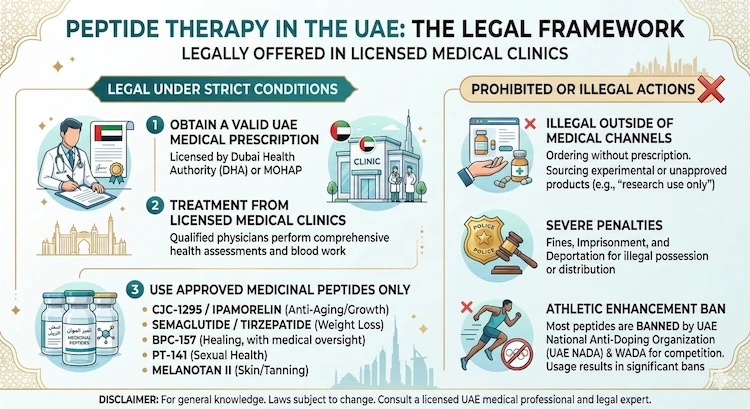
Check if your peptide plan is legal in the UAE
TL;DR
- Peptide therapy is legal in the UAE when prescribed by a licensed physician.
- Self-administering peptides or buying them online without a prescription is not permitted.
- In Dubai, your clinic must hold a DHA facility licence and your doctor a DHA practitioner licence.
- Importing peptides from abroad without MOHAP approval can result in serious legal consequences.
- Always verify your clinic's licence at dha.gov.ae before starting any treatment.
Peptide therapy is one of the fastest-growing treatments in Dubai's wellness scene, and one of the most misunderstood. If you have been researching it online, you have likely found protocols, dosing guides, and suppliers from the US, UK, or Europe. What those sources rarely tell you is what the rules are here in the UAE, where the regulatory framework is entirely its own.
That information gap has real consequences. We regularly see patients arrive at our clinic after self-administering compounds purchased from international vendors, with no prescription, no blood work, and no medical oversight. Some have unknowingly imported substances classified as controlled under MOHAP regulations. Others have used products with no quality assurance. In the worst cases, patients have experienced adverse reactions with no physician on record to manage them, which is a serious problem in a country where unlicensed medical activity carries legal penalties, not just clinical risk.
The good news is that peptide therapy is entirely legal in the UAE. But the conditions matter. This guide explains precisely what MOHAP and the DHA permit, what they prohibit, and how to access peptide therapy safely, legally, and with the clinical oversight it requires.
Key Facts at a Glance
What Is Peptide Therapy?
Peptide therapy refers to the clinical use of short chains of amino acids, the building blocks of proteins, to signal specific biological functions within the body. Unlike synthetic drugs, peptides are naturally occurring molecules that your body already recognises. Administered in targeted doses, they can influence everything from hormone production and cellular repair to fat metabolism and immune function.
In the UAE, peptide therapy has grown substantially in popularity over the past five years, driven largely by the country's large expat population, high-performance culture, and widespread interest in longevity medicine. Dubai's position as a regional wellness hub, with world-class clinics and year-round demand for performance optimisation, has made it a leader in regenerative medicine in the GCC.
How Peptides Work
Your body communicates internally through chemical messengers. Peptides function as highly specific signals. They bind to cell-surface receptors and initiate precise biological responses, without the blunt-force side effects associated with many pharmaceutical drugs.
BPC-157 (Body Protection Compound) is a synthetic peptide derived from a protein found naturally in gastric juice. Research published in Current Neuropharmacology has shown that it promotes angiogenesis and accelerates connective tissue repair. Sermorelin, a growth hormone-releasing peptide, stimulates the pituitary gland to produce more of your own growth hormone, rather than introducing exogenous hormone directly, which carries a greater risk.
CJC-1295 combined with Ipamorelin is another commonly used protocol in supervised clinical settings. This combination amplifies the body's natural growth hormone pulse without suppressing its own feedback mechanisms, according to research in the Journal of Clinical Endocrinology and Metabolism (2006).
CLINICAL NOTE: At Chairon House, our prescribing physicians assess each patient's hormonal baseline via comprehensive blood panels before recommending any peptide. In the UAE, this is not merely best practice. It is a regulatory requirement.
Is Peptide Therapy Legal in the UAE?
Yes. Peptide therapy is legal in the UAE, provided it is:
- Prescribed by a physician licensed by the DHA (in Dubai) or MOHAP (federally)
- Administered under appropriate clinical supervision
- Sourced through properly licensed pharmaceutical or compounding channels
- Documented in the patient's medical record
Self-administering peptides purchased online, importing unlicensed compounds, or receiving treatment from an unlicensed provider are all legally problematic and potentially dangerous in the UAE. For a broader overview of how peptide protocols are structured within this framework, our peptide therapy FAQ covers the most common questions patients ask before starting.
MOHAP: The Federal Regulatory Framework
The Ministry of Health and Prevention (MOHAP) is the UAE's federal health authority. MOHAP regulates the classification, import, distribution, and use of pharmaceutical and biological substances across all seven emirates. Under MOHAP's controlled substances framework, many peptides used in regenerative medicine are classified as prescription-only medicines (POM). This means they cannot be legally dispensed without a valid prescription from a MOHAP or DHA-licensed physician.
DHA: Dubai's Regulatory Layer
Within Dubai, the Dubai Health Authority (DHA) serves as the emirate-level regulator for all healthcare providers. Any clinic offering peptide therapy in Dubai must hold a valid DHA facility licence, and the prescribing physician must hold an individual DHA practitioner licence.
Abu Dhabi (DOH)
In Abu Dhabi, the Department of Health (DOH), formerly HAAD, serves as the equivalent regulatory authority. Peptide therapy is legal when prescribed and supervised by a DOH-licensed physician in a licensed facility.
HOW TO VERIFY A CLINIC BEFORE YOU COMMIT
- Check DHA facility licences at dha.gov.ae/en/licences
- Verify individual physician licences through the same DHA portal
- Ask the clinic for their facility licence number. Any reputable clinic will provide this without hesitation.
Which Peptides Are Commonly Used in UAE Clinics?
Not every peptide carries the same legal status. The table below outlines commonly used peptides in UAE regenerative medicine clinics and their general regulatory status.
CLINICAL OBSERVATION: We have seen a significant rise in patients presenting after purchasing peptides from international online vendors. In several cases, the compounds were mislabelled, under-dosed, or contaminated. Without licensed compounding oversight, there is no quality assurance.
Benefits of Peptide Therapy When Properly Supervised
Enhanced Recovery and Physical Performance
Many of our patients in Dubai are high-performance athletes, active professionals, or individuals recovering from surgery or injury. Clinical evidence suggests that peptides such as BPC-157 and TB-500 may significantly accelerate musculoskeletal repair and reduce inflammation. Most patients on a supervised tissue-repair protocol report noticeable improvement within four to eight weeks.
You can also read more about how peptides fit into a broader athlete performance and recovery programme.
Optimised Hormonal Balance
For patients over 35, growth hormone levels decline naturally, a process sometimes called somatopause. Peptides like Sermorelin and CJC-1295 stimulate the pituitary to restore more youthful GH pulses, which can support improved sleep quality, body composition, and energy levels. Unlike synthetic HGH injections, these secretagogues carry a lower risk of suppressing the body's natural endocrine feedback loop. For men specifically, this is often explored alongside testosterone optimisation.
Cognitive Clarity and Neuroprotection
Some peptides, including Semax and Dihexa, have shown promise in preclinical studies for supporting cognitive function and neuroregeneration. While human data remains limited, early clinical observations are encouraging, and research in this area is expanding. If you're exploring peptides specifically for mental clarity and focus, our guide to peptide therapy for brain health in Dubai goes into much more detail.
Weight Management Support
Peptides used in metabolic health protocols, including liraglutide derivatives and GLP-1 receptor agonists, are now MOHAP-approved for weight management in the UAE. At Chairon House, these are offered as part of a broader medically supervised weight programme, not as standalone prescriptions.Our GLP-1 guide for Dubai covers what's available, what's approved, and how these protocols are structured.
Who Is Peptide Therapy For?
You may be a good candidate for supervised peptide therapy if you:
- ✓ Are an adult (typically 30+) experiencing age-related decline in energy, recovery, or hormonal balance
- ✓ Are a competitive or recreational athlete looking to support recovery and performance legally
- ✓ Are an executive or high-output professional dealing with chronic fatigue, disrupted sleep, or cognitive decline
- ✓ Have been assessed by a physician and have identified specific hormonal or metabolic deficiencies
- ✓ Are looking for a more targeted, lower-risk alternative to synthetic hormone replacement
Who Should Not Have Peptide Therapy
Our physicians would not prescribe peptide therapy to patients who:
- ✗ Are pregnant or breastfeeding, as safety data in pregnancy is insufficient
- ✗ Have an active malignancy (cancer), as some peptides stimulate growth factors that could theoretically promote tumour activity
- ✗ Have a history of hormone-sensitive tumours (e.g., certain breast or prostate cancers)
- ✗ Are currently on immunosuppressant medications without specialist clearance
- ✗ Have severe renal or hepatic impairment
- ✗ Have a known hypersensitivity to any component of the prescribed formulation
- ✗ Are under 18 years of age
What to Expect: The Process at a UAE Clinic
Before Treatment
Your first appointment will involve a detailed medical history review, a discussion of your goals, and blood work. We typically assess hormonal panels (IGF-1, testosterone, thyroid, cortisol), metabolic markers, and organ function. This baseline is essential for selecting the appropriate peptide, dose, and protocol duration.Understanding what these markers indicate is also worth exploring our guide to metabolic health biomarkers explains what's being measured and why it matters.
During Treatment
Peptides are most commonly administered via subcutaneous injection, similar to insulin injections, though some formulations are available as nasal sprays, oral capsules, or topical applications. At Chairon House, patients are trained to self-administer injections at home after an initial clinic demonstration, consistent with DHA guidelines for home-use injectable protocols.
After Treatment
Protocols typically run from four weeks to six months depending on the clinical goal. Follow-up blood work is conducted at the four-week and three-month marks to assess response and adjust dosing. Our physicians are available between appointments via our patient communication portal.
Risks and Side Effects
Peptide therapy is generally well-tolerated, but it is not risk-free. The following side effects have been reported in clinical literature and in our own patient population.
Common (Mild)
- Injection site redness, swelling, or bruising
- Temporary water retention, particularly with GH-stimulating peptides
- Headaches in the first one to two weeks of treatment
- Mild nausea, particularly with GLP-1-based peptides at initiation
Less Common
- Fatigue or mild flu-like symptoms in the first week
- Flushing or warmth with some vasodilatory peptides
- Transient changes in appetite or sleep patterns
Rare but Important
- Hypoglycaemia (low blood sugar) with GH-stimulating protocols, mitigated by carbohydrate timing
- Antibody development, rare but possible with long-term use of synthetic peptides
- Pituitary desensitisation, a risk with continuous unsupervised GH secretagogue use
SEEK IMMEDIATE HELP IF YOU EXPERIENCE
Chest tightness or difficulty breathing
Severe dizziness following any injection
Signs of an allergic reaction after any injection
Cost of Peptide Therapy in the UAE
Peptide therapy costs vary significantly based on the specific compound, protocol length, clinic tier, and whether the treatment is combined with other services such as IV therapy or hormone optimisation.
Prices vary based on individual protocols, peptide sourcing, and clinical complexity. A personalised quote is always provided following your initial consultation. We do not offer one-size-fits-all packages as every protocol is individualised.
Frequently Asked Questions
Is peptide therapy approved by the UAE government?
Individual peptides and their specific medical uses fall under MOHAP and DHA pharmaceutical and prescribing regulations. When prescribed by a licensed physician for an appropriate clinical indication, peptide therapy is fully legal and compliant with UAE health law. Self-medication, unlicensed importation, and administration outside a supervised medical context are not permitted.
Can I bring peptides into the UAE from abroad?
Importing prescription medications into the UAE without MOHAP approval is illegal. Even if a peptide is legally available over-the-counter in another country, it may be classified as a prescription-only or controlled substance here. Travellers have faced serious legal consequences for carrying unapproved medications through UAE customs. Always obtain your prescription through a UAE-licensed clinic.
How do I know if a UAE clinic is legally allowed to offer peptide therapy?
Every healthcare facility in Dubai must hold a DHA facility licence, and every prescribing physician must hold an individual DHA practitioner licence. You can verify both at dha.gov.ae. Ask any clinic for their facility licence number before beginning treatment. A trustworthy clinic will provide this immediately.
How long does it take to see results?
Results vary depending on the peptide, your individual baseline, and your goal. Tissue repair protocols like BPC-157 often show improvement within four to six weeks. GH-stimulating protocols may take eight to twelve weeks for noticeable changes in body composition, sleep, and energy. Anti-ageing protocols are typically evaluated over three to six months.
Is peptide therapy safe for long-term use?
Long-term safety data for many peptides is still developing. For well-studied compounds like Sermorelin and BPC-157, clinical use over several months has a reasonable safety profile when properly supervised. Our clinic follows cycling protocols to prevent receptor desensitisation and maintains ongoing monitoring to detect any adverse changes.
How is peptide therapy different from anabolic steroids?
Anabolic steroids are synthetic testosterone derivatives associated with cardiovascular risk, liver damage, hormonal suppression, and psychological effects. Peptides are not steroids. They work through receptor-level signalling rather than direct hormonal flooding, and their side effect profile is generally much milder. In the UAE, anabolic steroids without a prescription are illegal. The same supervised-use rules apply to prescription peptides.
How do I book a consultation at Chairon House?
You can request an initial consultation through our website or via WhatsApp. Our patient coordinator will arrange a convenient time with one of our DHA-licensed physicians. The consultation involves a health history review and a discussion of your goals. There is no obligation to proceed with any treatment following your consultation.
Disclaimer
This article is for informational purposes only and does not constitute medical advice. The regulatory information provided reflects publicly available UAE guidelines as of the date of review and is subject to change. Please consult a DHA-licensed physician before beginning any treatment. For the most current MOHAP or DHA regulatory guidance, refer directly to the relevant authority's official publications.
Using peptide therapy safely and legally in the UAE
Peptide therapy in the UAE is not a regulatory grey area; it is clearly allowed when prescribed by licensed physicians, dispensed through approved channels, and documented correctly. The real risk lies in self-imported products, unlicensed online vendors, and protocols without medical oversight, which can create both legal and clinical problems. If you want the benefits of peptide therapy while staying firmly inside MOHAP and DHA rules, working with a licensed clinic such as Chairon House gives you a structured, compliant pathway instead of guesswork.
Book a licensed peptide consultation in Dubai
Peptide therapy in the UAE is legal only when prescribed and supervised by properly licensed clinicians in licensed facilities. A consultation at Chairon House includes a full medical review, blood work where appropriate, and a clear explanation of your options so you can access treatment with confidence in both the clinical and legal framework