March 5, 2026
Peptides for Athletic Performance: A Complete Guide
Medically supervised peptide therapy in Dubai, including BPC-157, TB-500, CJC-1295, Ipamorelin, and GHK-Cu, tailored to support recovery, tissue health, and long-term athletic performance at Chairon House.
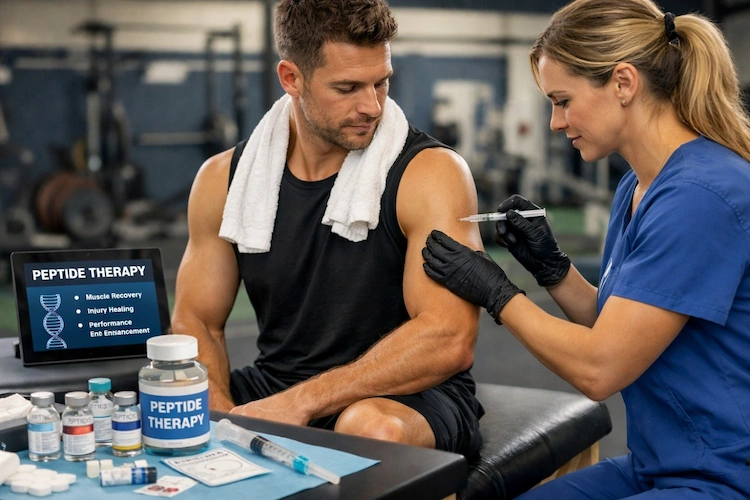
Peptide recovery protocols, built around your training
If you train seriously, you have probably heard about peptides by now. Maybe a training partner mentioned them. Maybe you stumbled across them while researching recovery. Either way, there is a lot of noise out there, and most of it is not very helpful.
This guide cuts through that. We have focused specifically on the peptides that are actually relevant to athletic performance and recovery, the ones being used in supervised clinical settings for real goals: building muscle, recovering faster, healing injuries, and staying in the game longer.
No fluff. Just what you need to know.
What Are Peptides, and Why Do Athletes Use Them?
Peptides are short chains of amino acids. Your body already produces them naturally, and they play a key role in signalling various biological processes, including growth hormone release, tissue repair, and inflammation control.
Peptide therapy uses specific synthetic or bioidentical peptides to support those same processes in a more targeted way. For athletes, that translates to things like faster recovery between sessions, better muscle repair, reduced injury downtime, and improved body composition over time.
The reason peptides have become popular in performance settings is that they work with your body rather than overriding it. They are not steroids. They do not flood your system with synthetic hormones. They prompt your body to do more of what it already does naturally, just more efficiently.
The Best Peptides for Athletic Performance
Here is a breakdown of the peptides most commonly used in athletic and performance settings, what each one does, and who it tends to work best for.
BPC-157: The Recovery Peptide
BPC-157 is one of the most well-regarded recovery peptides in both clinical and athletic settings, and the results people report are hard to ignore. It is derived from a protein naturally found in the stomach lining, which is part of why it has such a strong track record in tissue repair and anti-inflammatory support.
For athletes, the most relevant applications are tendon and ligament healing, joint health, muscle soreness recovery, and gut health, which affects performance more than most people realise. People who have undergone supervised BPC-157 protocols in Dubai report faster relief from acute injuries, noticeably reduced inflammation within the first week, and a meaningful improvement in how quickly they can return to full training capacity.
One important distinction worth knowing: BPC-157 tends to work particularly well for fresh or acute injuries, where tissue repair is the primary need. For long-standing chronic issues that have been building for years, it can still help, but results are typically more gradual and work best as part of a broader treatment plan rather than as a standalone fix.
That distinction is actually one of the reasons a proper clinical assessment matters before starting.
A good protocol is tailored to your specific situation, whether that is an acute injury, ongoing wear and tear from high training volume, or a combination of both.
- Best for: acute injury recovery, tendon and ligament health, joint inflammation, muscle soreness, gut repair
- What people report: faster pain relief, visible recovery improvements within the first few weeks, better training consistency
(Available at Chairon House as part of a supervised BPC-157 Dubai recovery protocol)
TB-500: Muscle Repair and Anti-Inflammatory Support
TB-500 is a synthetic version of Thymosin Beta-4, a peptide your body naturally produces when it needs to repair tissue. Its primary mechanism is promoting cell migration and proliferation, which together drive recovery in muscle, connective tissue, and soft tissue more broadly.
In athletic settings, TB-500 is used to support muscle recovery after intense training, reduce systemic inflammation, and aid healing from overuse injuries. People who have used it in supervised protocols report improvements in mobility, a noticeable reduction in the chronic soreness that builds up during heavy training blocks, and a faster return to full strength after injury.
For athletes in the UAE managing demanding training schedules, it is one of the most practical tools available for peptides for muscle recovery.
TB-500 is frequently paired with BPC-157 because the two cover different parts of the recovery process. BPC-157 tends to work more locally at the site of injury, while TB-500 has broader systemic effects on inflammation and tissue flexibility. Together, they address recovery from multiple angles, which is why the combination is popular for athletes dealing with significant injury or high training loads.
Together, they address recovery from multiple angles, which is why the combination is popular among athletes in Dubai who are dealing with significant injuries or high training loads.
As with any peptide protocol, results are most consistent when dosing, timing, and duration are guided by a clinician who can monitor your response and adjust as needed. That is exactly the kind of oversight that separates a well-designed recovery protocol from a guesswork approach.
- Best for: muscle recovery, systemic inflammation, soft tissue healing, high-volume training periods
- What people report: improved mobility, reduced soreness during heavy training blocks, faster recovery from overuse injuries
(Available at Chairon House as part of a supervised recovery protocol)
BPC-157 and TB-500: Why This Stack Works So Well Together
If you are dealing with a sports injury in Dubai or pushing through a demanding training cycle, BPC-157 and TB-500 together tend to produce better outcomes than either does on its own. The reason is that they work through complementary mechanisms.
BPC-157 supports localised tissue repair: it promotes new blood vessel formation, aids gut and soft tissue healing, and reduces inflammation at the site of injury. TB-500 works more systemically, improving the flexibility and repair capacity of muscle fibres across the body and reducing overall inflammatory load.
People who have run this combination in supervised clinical settings report significant improvements in injury recovery timelines. Acute injuries in particular tend to respond well, with some people reporting near-full function within three to four weeks of a structured protocol.
The combination works best when it is part of a properly designed supervised peptide protocol in Dubai, with the right dosing, duration, and follow-through.
That is what Chairon House offers for athletes who want to use these peptides the right way.
CJC-1295: Growth Hormone Support and Lean Muscle
CJC-1295 is a growth hormone-releasing hormone analogue. What that means, practically, is that it stimulates your pituitary gland to release more growth hormone, which, in turn, supports muscle protein synthesis, fat metabolism, and recovery.
Unlike taking growth hormone directly, CJC-1295 works by amplifying your body's own production, which means the release is pulsatile and more natural in its pattern. It is commonly used to improve body composition, support lean muscle development, and enhance sleep quality and recovery.
CJC-1295 is often paired with Ipamorelin to produce a stronger and more sustained growth hormone response without the side effects associated with higher doses of either compound alone.
- Best for: lean muscle development, body composition, improved recovery quality, sleep optimisation
- How it works: stimulates natural growth hormone release from the pituitary gland, supports protein synthesis and fat metabolism
Ipamorelin: Clean Growth Hormone Release
Ipamorelin is a growth hormone secretagogue, which means it triggers growth hormone release. What makes it stand out from other peptides in this category is its selectivity: it produces a clean GH pulse without significantly raising cortisol or appetite, which are common unwanted effects with other GH-stimulating compounds.
For athletes, that selectivity matters.
You get the recovery and body-composition benefits of elevated growth hormone without the hormonal disruption that can come with less-targeted approaches.
Ipamorelin is popular with people who want to support muscle maintenance, improve recovery between sessions, and see gradual improvements in body composition over a sustained protocol.
- Best for: clean growth hormone support, body composition, muscle maintenance, recovery between sessions
- How it works: selectively stimulates GH release without significantly affecting cortisol or other hormones
GHK-Cu: Collagen, Tissue Integrity, and Longevity
GHK-Cu (Copper Peptide) is a naturally occurring peptide that has been studied for its role in collagen synthesis, tissue repair, and regenerative processes. It is commonly associated with skin health and anti-aging, but its relevance for athletes goes beyond aesthetics.
Collagen is the structural protein that holds connective tissue together: tendons, ligaments, cartilage, and the extracellular matrix of muscle. As training volume increases, the demand on connective tissue increases too. GHK-Cu supports the body's ability to maintain and repair that tissue, which is particularly relevant for athletes dealing with wear and tear over time.
- Best for: connective tissue health, collagen support, tissue repair, performance longevity
- How it works: stimulates collagen synthesis, supports tissue remodelling and regeneration
Peptides at a glance
Are Peptides Safe for Athletes in Dubai?
The safety picture for peptides depends a lot on which peptide you are talking about, how it is sourced, how it is dosed, and whether there is medical supervision involved.
The peptides covered in this article have generally been well-tolerated in clinical settings, and many have been studied specifically in athletic and performance contexts. That said, no compound is risk-free, and the peptide market includes a significant amount of unregulated, poorly sourced products that introduce real risks regardless of the compound itself.
The other consideration for competitive athletes is anti-doping. Several peptides used in performance settings appear on prohibited substance lists, so it is worth checking the status of any compound against the relevant anti-doping authority for your sport before starting anything.
For athletes in Dubai and the UAE specifically, it is worth knowing what to look for in a local provider. A reputable clinic offering peptide therapy in Dubai should be able to provide full transparency on compound sourcing and quality standards, require a clinical assessment and relevant lab work before prescribing anything, offer ongoing monitoring throughout the protocol rather than a one-time prescription, and have qualified medical professionals overseeing the programme.
The UAE has clear standards around medical practice and pharmaceutical quality, and any clinic operating to those standards will be comfortable answering detailed questions about their sourcing, protocols, and clinical oversight. If a provider cannot or will not answer those questions clearly, that is a signal to look elsewhere.
The simplest way to stay on the right side of all of this is to work with a clinic in Dubai that knows what it is doing, uses pharmaceutical-grade compounds, and builds your supervised peptide protocol around your specific situation rather than a generic template.
How Chairon House Supports Athletic Performance with Peptide Therapy in Dubai
At Chairon House, peptide therapy is part of a broader, medically supervised performance protocol. That means the team starts with a thorough assessment of your health markers, training demands, recovery patterns, and goals.
BPC-157 and TB-500 are available at Chairon House as part of supervised recovery protocols in Dubai, particularly relevant for athletes dealing with sports injuries, high training loads, or connective tissue health. Every protocol is individualised, not templated, and is monitored throughout so dosing and timing can be adjusted based on how you are responding.
Peptide therapy at Chairon House also integrates with the other tools available: structured training programming, recovery sessions, and metabolic support. The idea is that peptides work best as part of a system rather than as a standalone intervention.
If you are serious about your training and want to understand whether peptide therapy in Dubai is relevant for your goals, a consultation is the right starting point. Book a session at Chairon House to get a proper assessment and find out what a supervised peptide protocol in Dubai would look like for you.
Using peptides the right way in Dubai
Peptides can absolutely move the needle for athletes—especially when you are dealing with real training volume, real injuries, and real performance goals—but only when they are used inside a system that respects both physiology and regulation. At Chairon House in Dubai, peptide therapy is one tool inside a broader, medically supervised performance protocol, designed to support your recovery, tissue health, and longevity in sport rather than replace smart training, nutrition, or rest. If you want to explore whether that approach is right for you, the next step is a structured assessment, not guesswork.
Find out if peptide therapy fits your performance plan
Peptides are not a shortcut, and they are not right for everyone—but in the right context, they can be a powerful tool for staying healthy and performing at your best. Book a consultation at Chairon House in Dubai to map out whether a supervised peptide protocol makes sense for your goals, and how it would fit into your existing training and recovery system.